10:17 PM, Wednesday, October 16
Having spent my early childhood and teen years in a hazy dream of rolling pastures, fields, and forests, coming to the city felt like splashing my face in cold water after a long sleep. I had finally stepped out of the world’s periphery into a place where reality felt more “real,” and even uncertainties were certain. Mysteries were of a very human nature, the result of mundane cause and effect. I was unaware that the gradient of “unreal” and “real” was circular, and the farther you thought one was behind you, it was actually ahead of you, just obscured by what you believed to be its opposite.
I was brought up to believe there was something above humanity. Something that guided us as a species, giving us our imagination, and our creativity. I was taught that this force acted upon and moved through us, and could be seen in everything created by human hands. I learned the history of the land and its people, the countless ways this force had left its mark on time—the miracles and the abominations. I was trained to attune myself to this force and to act in harmony with it to create pure expressions of the gift we as humans were so blessed with. And I was warned of how the outside world had forgotten this gift, treating it not as the blessing it was, but as a resource to be exploited, abused, and depleted.
What I saw that night made me realize something. For my whole life, I and everyone around me had been wrong—or at least we had only seen a small part of the truth and accepted it as a whole. There was more than one way to touch the raw power of creation without spoiling it, and its connection ran far deeper than something analogous to the air we breathed.
I was seeing something I wasn’t supposed to. It was just me and her in the train car until they showed up—two men in trench coats and wide-brimmed hats. Right away, my instincts buzzed in an alarm only I could hear. Like the foxes that stalked the pastures of my village, they exuded a predatory intent far more basic than the cold rage or hot passion of a human before an act of violence. This was something unnatural, clothed and groomed to blend in with the construct around it, motivated by a sense of survival that should not exist in a human. A complex system of emotions that signified the need for an exchange: death for life.
The woman across from me, whose name I didn’t yet know, had been staring absently out the window into the dark tunnels our train sped through. As soon as the two interlopers stepped into our car, her eyes darted in their direction, and one of her hands moved quietly but swiftly toward the long, cylindrical bag over her shoulder.
The two men—if they were indeed men—stood side by side in the middle of the car. In appearance, they were too ordinary, as if they were window dummies given the means to move under their own power, faces that looked identical but lifeless, without personality or history. And this was reflected in their radiance—far too uncomplicated, lacking the oscillations and random interference that indicated an active inner world. Yet, the constant intention they exuded… They were something I had never encountered before. Ideas given flesh.
The automatic doors closed. As I learned later, the security cameras in the car had been shut off as well to more easily create an isolated system, cutting it off from the outside world and turning it into a place that, for a short time, could not be observed, and where anything was possible. At the time, all I knew was a primal unease—what a hare felt before it could see the fox but could sense eyes on it. It was all that saved me from the first stroke of the blade.
I moved before I was aware I had moved, landing cat-like on the cold, dirty floor of the train car, a metallic ringing filling the air as the handrail between the doors and where I had been seated split in two. One of the trench-coated men had swept his arm at a horizontal angle, where his hand once was now replaced by a glinting blade.
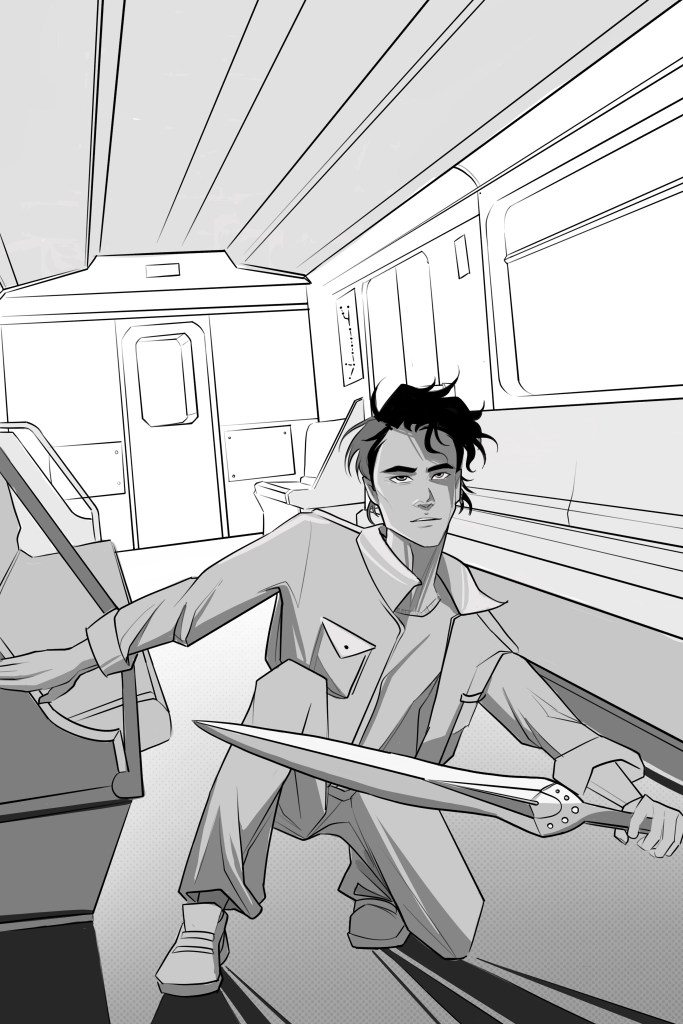
My instincts kicked into overdrive, millennia of civilization burning to fuel survival at all costs. I had, at maximum, two seconds to plan my next move. Each photon that hit my retina was precious information, possibly the only thing standing between my continued existence and the end of it.
In front of me, the man who had tried to kill me. To my left, the other man, in the midst of swinging his own blade-hand at the young woman, but he would miss his mark. She was already out of his reach.
She had leaped from her seat, launching into the air and curling into a tumble. In one gloved hand, she clutched what I—in my analytical state of mind—compared to a marching band leader’s baton. Her other hand was outstretched as if it was both guiding her movement and setting a target.
The gaze of her sharp eyes was broken from the man for only an instant, when in that second divided by a moment, they met mine.
I didn’t have time to think of what this could mean. All that existed was now, and now encompassed the whole of London’s history. Everything that had ever existed here could exist now. I reached into the Ocean of Souls, and grasped bronze.
The motion of time snapped back to its normal pace. The train car softly rumbled beneath me. In my hand, I felt the weight and cold metal of a Bronze Age sword. It would be too weak to withstand a blow from the strange man’s blade, but more than strong enough to rend flesh, which my senses told me he was made out of.
One strike was all it would take—two if I wanted to be thorough. If I was accurate, fast, and in tune with my surroundings, I could end this quickly. Whatever was happening elsewhere in the car would be my concern then.
He lunged, closing the gap between us faster than any human could. I twisted my body out of his trajectory, tossing my sword from my right hand to the left, flipping it into a backhanded position. I closed my eyes, accepting the conclusion I had chosen.
Like a punctuation, a meaty squelch hit my ears as the shock of impact vibrated up my arm. My eyes stayed closed; I didn’t need to see the result as long as I could feel it.
The thing had the body of a human. The resistance was roughly equal to that of a pig carcass, though narrower, as the length of the blade had pierced through to the hilt. I estimated the hit had landed a few centimeters above the navel. Warm fluid trickled onto my hand. That would likely be a killing blow, but I couldn’t predict how a being like this would react to something that was fatal to a human, and if the body and mind were not connected properly, a delay was possible. I needed to sever the connection entirely to shut the whole system down.
This would have to be done quickly and efficiently. I jerked the blade forward and out of the man-creature’s torso, then turned my whole body, leading with the sword to carry the force of my momentum and concentrate it into the thin edge of the blade.
The thick, wet sound of flesh, muscle, and bone separating from itself indicated the attack had hit its mark. I had heard it before at the annual slaughter, and had smelled the scent of fresh blood in the air. It did not pair well with the smell of the city, how it invaded the collective illusion of safety like a fungus worming its way through firewood.
The sword in my hand faded, and my fingers flexed in empty air as if clutching for something I had held in a dream. Only now did I allow myself the privilege of sight, and for years of finely-tuned instinct to give way to common sense.
What I saw should have been impossible.
The other man had been reduced to his elementary components, more than dust but less than viscera. In the steaming puddle of what used to be a human shape, all that remained were his clothes.
The woman stood over the mess, baton clutched horizontally, wisps of smoke curling from both ends. It was a peculiar-looking device that, despite its similarity to commonplace objects, I had no name for. It somehow complemented her aesthetic, itself relatively commonplace but at the same time all wrong.
Never mind the fact she had somehow severed the bonds that held a living being together—something far beyond the limits of human capability, even if one was allowed certain shortcuts.
Sharply, she turned to face me, her expression somewhere between anger and confusion for an instant before a smile I would come to know well spread across her lips.
“Well, if I’d known you could fight like that I might have said hello a long time ago.”
She spoke in an Eastern-tinged accent. Later I learned it was Pakistani. Her voice was deeper than I’d expected—boyish in a way. But what kind of a greeting was that, anyway?
“I’m sorry, I—” For some reason, words were failing me. What would be appropriate after what we’d just been through—what I’d just done?
I looked back at my handiwork. A beheaded—and very much human—body lying in a pool of blood. I had taken a human life so easily.
“Save it, we need to clean this up. We’ll be at the next station soon.”
The woman trotted over to the corpse, kneeling and extending her hand over it. She mumbled a few words I couldn’t hear, then raised and lowered her baton three times, moving it from his neck to his feet. Steam began to rise from the body, and its clothes shifted as they were wrapped around a deflating balloon instead of a flesh and blood structure. Just as the remains of the one she had faced, where there was once a man was now a rapidly-degrading puddle of biological components. With barely a glance, she gestured to where the disembodied head had rolled, and it too began to dissolve—flesh giving way to muscle, then bone, until that too became a soupy paste, evaporating into the air of the train car and filtered into the ventilation, and out into tunnels around us.
With her task finished, she slid her baton back into her bag and zipped it up. Then, she stood.
“Do you have a safe place to go?”
It took a moment for her question to register. “Uh—I have a flat near Windom Park. Is that safe enough?”
“What kind of security do you have?”
“I think there are cameras—”
“How are you so good at fighting but so hopeless at home security?”
“I need to put in a request with the landlord if I want anything else installed.”
“That’d barely stop a burglar, let alone a magician. What’s that old movie line? Something like… Oh yeah: ‘Come with me if you want to live.’”
Outside the train car, the light of the station burst through the windows. The station looked deserted. Not many people were out this late on a weeknight. The train pulled to a stop, a voice announcing our arrival at East and Parkley, and the woman disembarked as casually as if the entire trip from the previous station hadn’t happened. Not knowing what else to do, I followed her.
At a brisk but (on her part) entirely unpanicked pace, we walked up the stairs, passed the ticked booths, and out onto the streets above, where a light mist-like rain had begun to fall. Traffic lights and store windows glowed in the chilly haze. There weren’t many pedestrians or cars out tonight, and the whole street had an eerie stillness about it.
“Who were they?”
At my question, the woman turned to look at me with an almost quizzical expression. “You’re an odd one. Not many people would be able to take down an opponent they knew nothing about in just two strokes. They weren’t human, in case you were worried. You didn’t kill anybody.”
“But they—“
“Think of them as an almost perfect copy of a work of art. They’re made of all the same material elements, but none of the really important stuff—you know, the identity, the soul. They were probably created just last week, specifically for tonight.”
She took off in a trot across the street without waiting for me to reply. I followed close behind, throwing a glance over my shoulder just be sure we weren’t being followed.
“You’re saying someone created a perfect copy of life for the sole purpose of killing you?”
“Yeah, pretty much.”
“Who would even be capable of doing something like that?”
“Good question.”
“And why try to kill you?”
“Not sure myself, but it’s kind of fun to be this popular.”
It was fortunate that no one else seemed to be out on the street, because this conversation would sound bizarre to anyone who happened to overhear.
Sharply, she turned down an alleyway. “Stay close.”
“Where are we going?”
“My flat. It’s much safer than yours, trust me.”
“Okay… I don’t even know your name.”
“Could say the same to you.”
“Pierce—Jarren Pierce.”
She broke her stride, turning around and extending a hand. “Nice to meet you, Jarren Pierce, you can call me Mahnoor.”
Not knowing what else to do, I took her hand and shook it, the damp leather of her gloves slightly warm and soft to the touch. She had a firm grip.
“Well, now that we’re acquainted, maybe you can enlighten me about something. How exactly does someone conjure an ancient sword out of nowhere? That’s not any kind of magic I’ve ever heard of.”
“Magic? No, it’s not magic, it’s just…” I struggled to come up with a comparison that didn’t make it sound like magic. “It’s like reading blueprints.”
“Blueprints that bend thermodynamics and causality? Now that’s something I’ve never seen before.”
“Well, what about that thing you did?”
“Oh, that was just magic. No big deal. Come on, it’s this way!”
Mahnoor knew these alleys well. In this part of the city, they formed a complex digestive tract where all the refuse of the streets ended up. I had always avoided them, not just because they were unclean, but for how looking into them awakened some instinctual revulsion, as if I was staring into a dark pit with no visible bottom. An ancestral memory, perhaps, of when we sought out caves for shelter, but sometimes they led to places that were impossible to find one’s way out of. Somehow, though, she seemed to know exactly where she was going. Illuminated by the dull orange glow of the sky and the occasional window, we made our way deep into this winding network, my anxiety only kept at bay by the hope that our destination was getting nearer.
When we emerged onto the street again, it took a few moments longer than it should have for me to recognize where we were. Somehow, without crossing a single roadway, we had ended up on the other side of Langstaff. Northbank had a reputation for being the more “rough and tumble” part of town, where it was possible to find the most fun and the most danger. I had passed through on occasion but never lingered, and while I fully intended to give it a more thorough look at some point, I hadn’t intended tonight to be that time.
Here, things were a bit more lively. Though the night was chilly and the rain was getting heavier, there were some people out on the streets, many of them young, and in clothes that looked fit for clubbing. A thumping beat emanated from one of the establishments, which flooded neon light onto the shiny pavement.
Mahnoor only stopped for a moment, looking up and down the street before taking off in a jog.
“Come on, let’s get out of this rain!”
I stuck as close as I could without feeling intrusive. Absolutely nothing about her behavior suggested the insanity we had just taken part in.
The building where Mahnoor lived was no more or less remarkable than any of the others in this part of town. It was clearly cheap, but I could never fault anyone for living within their means, since I lived no differently. Considering her sense of dress, I might have expected something a little more upscale if her attitude had matched my preconceived notion of someone who dressed like that. Her casualness, on the other hand, lacked any snobbery—at least from what I could tell by the few words we’d exchanged. Her flat was on the third floor, and was hot and dry. It was also quite bare, with an admittedly nice rug, a bookshelf, a sofa, and a chair being the sole furnishings of the sitting room. She didn’t have a TV as far as I could tell. It smelled of a spicy yet sweet incense.
“Make yourself comfortable, I’ll put on some tea.”
She hung up her coat and hat by the door, taking off her shoes as well. Not wanting to be impolite, I did the same.
The kitchen was adjacent to the sitting room, separated only by a counter. Without a hint of urgency, she went about putting on a kettle and switching on a little radio sitting that sat plugged into the wall. Rather than music, it was some kind of talk show, although I couldn’t understand the language being spoken.
At this point, it struck me that I had to say something—anything. Another question would be logical, but as nothing about this situation was logical, my options were severely limited. I decided to keep my mouth shut until she decided to start talking, doing as she suggested and making myself comfortable on the far end of the couch. Doubts flooded my mind, everything from simple questions of etiquette to whether I had just gone from one deadly situation to another. Trying my best not to be too obvious about it, I scanned the architecture of the room, noting each possible exit—windows and all. Materializing a weapon would be more difficult, owing both to my exhaustion and proximity to the ground, but as long as I could touch the Greater Soul, I could borrow some of its strength.
Mahnoor came into the room with two steaming cups of tea, setting them down on the coffee table and sitting cross-legged on the floor, leaving the entire couch to me.
“Whew, that was exciting, huh? Ever fear for your life like that?”
Not at all how I expected her to open the conversation.
She continued without waiting for me to reply, perhaps seeing that I was lost for words. “You know, it’s a lucky thing you were on that train with me. Anyone else wouldn’t have stood a chance. Where did you learn to fight like that?”
“It’s something almost everyone in my village learns. It’s tradition.”
“Never been one for tradition, but I like the sound of yours. Can everyone in your village fight like you?”
“I…took it a little more seriously than most. There’s not much reason to fight these days, but there’s more to it than that.”
“Ah, you have the right attitude. Learning a martial art is learning history, culture, self-discipline, respect… Can’t pretend I know much of the Western forms, though.”
“As far as I know, only people in my village practice it.”
“Hmm, so I wouldn’t know about it anyway. Secrets really are powerful things. I’d have no defense against it.”
“Yeah, the more mystery something has, the more powerful it is. That’s what we’re taught. I’m not really supposed to do what I did in front of people that aren’t… Well, people like you.”
“’People like me?’ I feel like I should be offended, but I understand what you mean. I’m not supposed to do what I did in front of people like you, either. I guess that means we’re both outlaws now.”
I shrugged. “If you don’t tell on me, I won’t tell on you.”
“I’m good with that. So, tell me Jarren, what brings a country boy like you to the big city?”
Did she really have to put it like that? And even if it was technically part of London, Langstaff didn’t feel like the “big city.”
“School. Well, I wanted to see what the rest of the world looked like. You know, get some context, figure out what the point of it all was. School was the best way to do that.”
“Hmm, was it, now? Hey, don’t let the tea get cold, it’s only good when it’s hot!”
Bouncing from that sarcastic sounding answer to chiding me in an almost parental tone acted as a small electric shock, making me more aware of my surroundings. I’d forgotten all about it, but the sweet smell of chai spices had drifting into my nose without my noticing it for the past few minutes. It was still hot, and I recoiled as it touched my lips. I heard Mahnoor snicker, but she said nothing. I just felt stupid, but in this I found the courage to ask a stupid question.
“So, you’re a magician?”
“What else would I be?”
“You’re just…not exactly what I picture when I think of ‘magician.’”
“What exactly are you implying?”
“I was thinking more robes and potions and crumbling castles deep in the woods, not London flats and traveling on the underground.”
Mahnoor returned to her spot by the table, taking a sip from her teacup. She grinned, impishly.
“We’ve got to keep with the times, just as much as everyone else.”
“Are there a lot of you?”
“Oh yeah, all over. We’re just good at blending in. It makes things simpler if we don’t draw attention to ourselves.”
“So, it’s something you’re born with? Magic, I mean?”
“I was. It helps, for sure. Were you born with that thing you can do that ‘isn’t magic?’”
She was making fun of me, but there was genuine curiosity in her words. I decided to humor her as best I could.
“I think it’s something everyone’s born with, it just expresses itself differently between different people, and for me…”
She tutted, nodding along to what I was saying. “I’ve never heard of anything like this. If I hadn’t seen it myself, I’d think you were making it up. I love a mystery… You seem to be taking all of this pretty well.”
“Just getting my bearings, I guess.”
“Hmm, most people would be a little more freaked out after what just happened. You seem calm. It’s almost creepy.”
In truth, I was terrified. The fact I had accepted all my life, that my small community was the last vestige of Receivers: people who could touch the Greater Soul, was incorrect. Worse still, not only did many of these people exist, they could do things I was taught were impossible. Things that defied our place in nature.
I replied simply. “I’m just kind of processing everything right now. It’s hard to accept.”
“Didn’t expect to find out magic exists, did you? Although I’d argue you’ve been doing a form of magic yourself.”
“I told you, it’s not magic.”
“Magic is just a word for things that defy everyday rationality. For me, everyday rationality includes magic, so I guess that makes you doubly magical.”
“What is magic to you, anyway?”
“Applied physics. What’s that thing you do? And don’t say ‘reading blueprints,’ that’s not gonna fly with me. I need facts.”
I struggled to think of something that would make sense to someone who had never heard of any of the things I’d grown up with. Reading blueprints was the quickest, simplest comparison, and if that was off the table…
Simple words couldn’t capture how it felt to plunge into the sea of history, converting the pressure exerted by the past on the present into energy that could be harnessed in defiance of the flow of time, spontaneously realizing the creations archived in the Greater Soul of the Earth. How everywhere I went, I could hear a sound no one else could, that told the story of the land and its people.
My eyes strayed to my teacup. A few tiny pieces of ground leaves had floated to the surface. It was an improvised metaphor, but it would suffice.
“You know when there’s something at the bottom of a cup, and when you add liquid it gets pushed up to the surface?”
“Yeah, I’m familiar.”
“History is like that. The past doesn’t stop existing just because no one’s experiencing it. Everything that has ever existed still exists, in every state it existed in. And that existence has energy and mass. The forward motion of time is the past exerting pressure on the present. So I guess the present is like the surface of a fluid, and everything in it is the stuff floating on top. Except all the stuff floating on top is also where it was at an earlier point.”
“So, you’re saying that motion is just the illusion of us only being able to perceive time in ‘moments.’ That would mean points are actually lines, lines are actually squares, squares are actually cubes, etcetera?”
She was catching on much faster than I’d expected. Modifying the language to adhere to scientific principles seemed to have been the right move. As it turned out, physics and the traditions of my people had quite a bit in common.
“Yeah, that’s the idea. I’m taking a small measure of energy that the collision of past and present produces, and using it to rematerialize a moment that is no longer perceivable.”
“You make it sound like no big deal, but that sounds like a bloody big deal to me. Is this common knowledge where you come from?”
“Sort of. The big picture, anyway. It’s the finer points that are a bit more…esoteric, I suppose.”
“I can’t tell if you’re a monk, a professor, or a madman, but this is all so… Well, I wouldn’t have pegged you for such a man of mystery, but I seem to have stumbled on something impossible, tonight.”
 i·de·a·mat·ter